

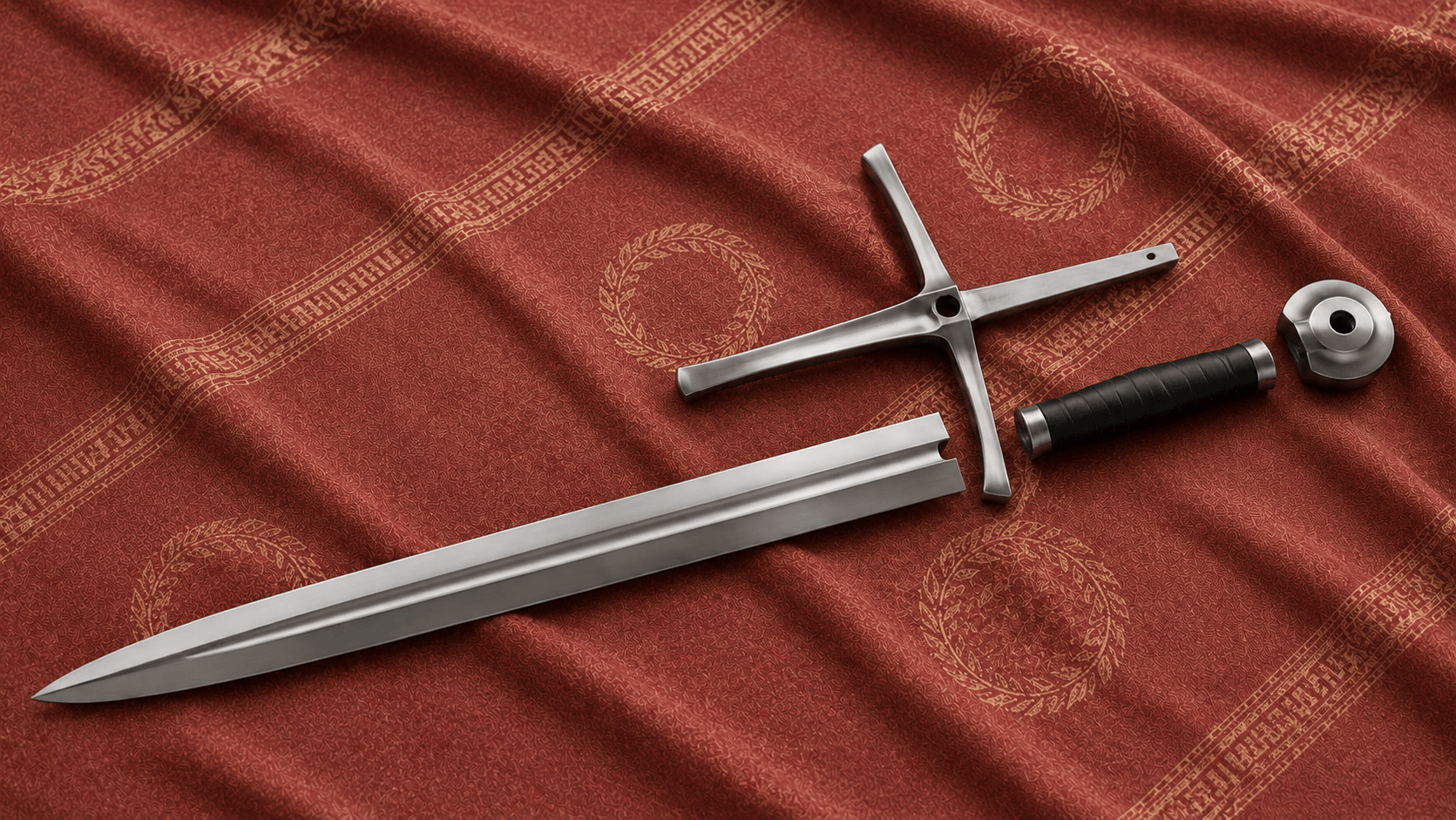
Whether you’re a collector, history enthusiast, or simply curious about how swords are designed, understanding the different parts of a sword helps you appreciate both their craftsmanship and function.
Although swords have evolved across cultures and centuries, most share the same fundamental anatomy. Every component—from the razor-sharp point to the weighted pommel—plays a specific role in balance, durability, handling, and combat performance. Even a small change to one part can dramatically affect how a sword feels and performs in the hand.
In this guide, we’ll break down each part of a sword in simple terms, explain what it does, and show how all the components work together. You’ll also learn the differences between European and Japanese sword anatomy, discover common myths, and gain a better understanding of what makes a well-designed sword.
Whether you’re buying your first replica, researching historical weapons, or simply expanding your knowledge, this guide covers everything you need to know about sword anatomy.
What Are the Main Parts of a Sword?
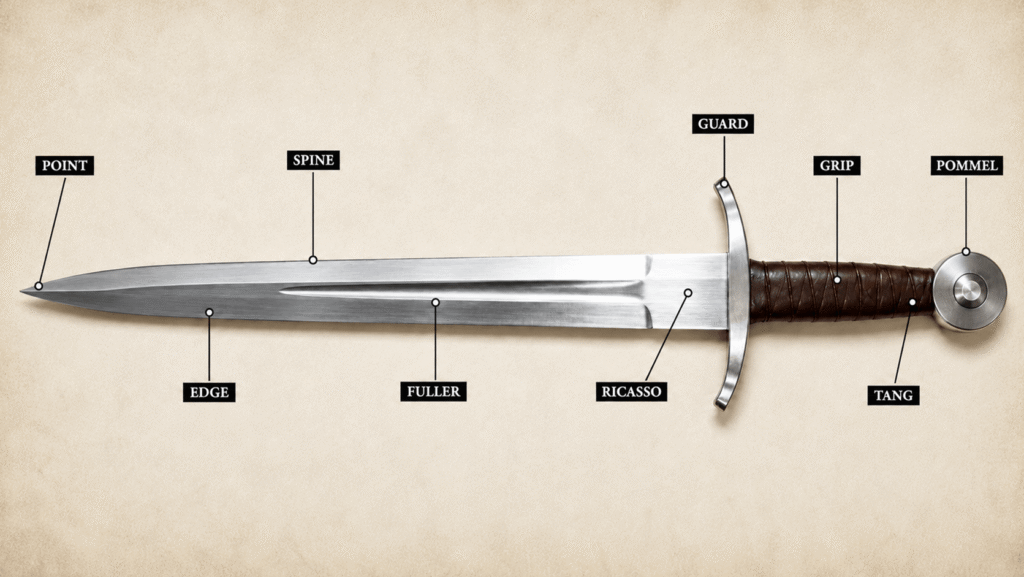
Although designs vary depending on the type of sword, most European swords consist of nine primary components:
| Part | Function |
|---|---|
| Point | The tip of the blade used primarily for thrusting. |
| Edge | The sharpened portion of the blade designed for cutting. |
| Spine | The unsharpened back of the blade that adds strength and rigidity. |
| Fuller | A groove forged into the blade to reduce weight while maintaining structural strength. |
| Ricasso | An unsharpened section located just above the guard on some swords. |
| Guard | Protects the user’s hand from an opponent’s blade. |
| Grip | The handle that provides comfort and control. |
| Tang | The extension of the blade hidden inside the hilt, connecting all components together. |
| Pommel | A counterweight at the end of the hilt that improves balance and handling. |
Together, these components create a weapon that is strong, balanced, and effective. Remove or poorly design just one of them, and the sword’s overall performance can be significantly affected.
Understanding Sword Anatomy
At first glance, a sword may appear to be nothing more than a blade attached to a handle. In reality, it’s a carefully engineered tool where every component has a specific purpose.
The blade is responsible for cutting, thrusting, and absorbing impact. The hilt—which includes the guard, grip, and pommel—allows the user to control the weapon while protecting the hand and balancing the sword’s weight. Hidden beneath these visible parts is the tang, arguably one of the most important structural elements, as it holds the entire sword together.
Different types of swords place greater emphasis on certain components depending on their intended use. A longsword built for armored combat, for example, may feature a longer grip for two-handed use, while a rapier prioritizes a complex guard to protect the hand during thrust-focused fencing. Likewise, Japanese swords use different terminology and construction methods, though the underlying principles remain remarkably similar.
Regardless of the design, nearly every functional sword is built around the same goal: creating the ideal balance between cutting power, thrusting ability, durability, and control.
Understanding these individual parts not only helps identify different swords but also explains why some weapons feel quick and agile while others deliver tremendous cutting force.
Main Parts of a Sword
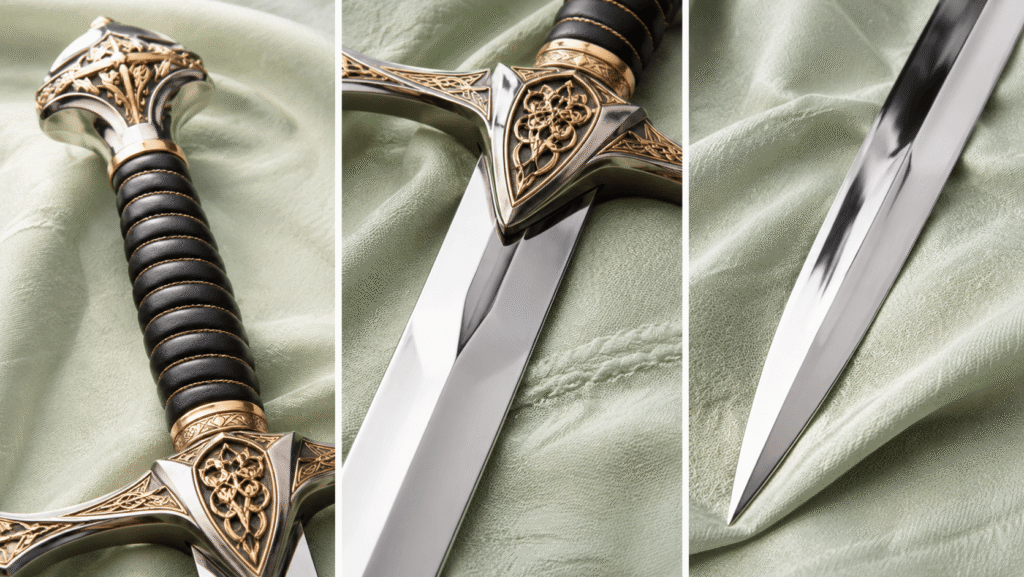
Although swords vary greatly in shape and purpose, nearly every traditional European sword is built around the same essential components. Each part has a specific function that contributes to the sword’s strength, balance, handling, and effectiveness.
Understanding these components not only helps identify different types of swords but also explains why certain weapons perform differently. For example, a sword with a longer grip offers greater leverage for two-handed use, while a larger pommel can shift the balance closer to the hand for improved control.
Let’s examine each part of a sword in detail.
Point
The point is the very tip of the blade and is primarily designed for thrusting attacks. While many people associate swords mainly with cutting, numerous historical weapons were specifically optimized to pierce armor, chainmail gaps, or vulnerable areas on an opponent.
The shape of the point varies depending on a sword’s intended purpose. A broad cutting sword often has a wider, rounded point that still allows effective thrusts, whereas weapons like rapiers feature long, narrow points designed almost exclusively for precision thrusting. Medieval longswords strike a balance between these two extremes, making them highly versatile in combat.
A properly designed point must be both sharp and durable. If it’s too thin, it can bend or break under heavy impact. If it’s too thick, it loses much of its penetrating ability.
Even though the point occupies only a small portion of the blade, it plays a major role in determining how a sword performs in battle. It’s one of the clearest examples of how every part of a sword serves a carefully engineered purpose.
Edge
The edge is the sharpened portion of the blade responsible for cutting. Depending on the sword’s design, it may have a single edge or two sharpened edges running along both sides of the blade.
A sharp edge allows the sword to slice efficiently through soft targets, while its geometry determines how well it cuts. Contrary to popular belief, historical swords weren’t always razor sharp like modern kitchen knives. Instead, they were sharpened to a practical angle that balanced cutting performance with durability.
Different swords use different edge profiles. Broad blades intended for powerful cuts typically have wider edge angles, while lighter weapons designed for speed often feature thinner, finer edges.
Keeping the edge in good condition is essential. Even a high-quality blade can lose much of its cutting ability if the edge becomes chipped, rolled, or excessively dull. This is why historical warriors regularly maintained and sharpened their swords between battles.
Whether the sword is designed for battlefield combat or modern collecting, the edge remains one of its defining characteristics.
Spine
The spine is the unsharpened back of the blade, opposite the cutting edge. While it may appear simple, the spine provides much of the sword’s structural strength and rigidity.
Think of the spine as the backbone of the blade. It helps resist bending during powerful strikes while supporting the overall shape of the sword. A thicker spine generally creates a stronger blade, although it also adds weight. Sword makers carefully balance these factors to achieve the desired handling characteristics.
Not every sword features the same spine design. Some have thick, flat spines for maximum durability, while others gradually taper toward the tip to reduce weight and improve agility.
Single-edged swords, such as falchions and messers, often rely heavily on a robust spine because only one side of the blade is sharpened. Double-edged swords still possess a spine, though it is typically less pronounced due to their symmetrical blade geometry.
Although the spine rarely receives as much attention as the edge or point, it’s one of the key elements that allows a sword to withstand repeated impacts without losing its structural integrity.
Fuller
One of the most misunderstood parts of a sword is the fuller – the long groove running along the blade.
Despite a popular myth, the fuller is not a “blood groove.” This misconception has been repeated for decades in movies, video games, and on the internet, but it has no historical basis.
The true purpose of a fuller is to reduce the blade’s weight while maintaining its strength. It’s similar to the I-beam design used in modern construction, where material is removed from areas that contribute less to structural rigidity. This allows the sword to remain lightweight without sacrificing durability.
Not every sword has a fuller, and those that do may feature one, two, or even several grooves depending on the blade’s design. Some fullers extend nearly the entire length of the blade, while others stop halfway or appear only near the hilt.
A well-designed fuller improves handling by making the sword feel faster and more agile, especially during prolonged use. Rather than weakening the blade, a properly forged fuller often enhances its overall efficiency by reducing unnecessary weight.
Today, the fuller remains one of the easiest features to identify on many medieval European swords.
Ricasso
The ricasso is the unsharpened section of the blade located directly above the guard. While not every sword includes a ricasso, it became increasingly common on many European longswords, greatswords, and Renaissance weapons.
Its primary purpose is to improve control. Because this portion of the blade isn’t sharpened, it can safely be gripped with a gloved hand during certain techniques. Historical fencing manuals frequently illustrate swordsmen placing one hand on the ricasso – a technique known as half-swording. This method gave fighters greater precision when thrusting into the gaps of an opponent’s armor.
The ricasso also creates a clear transition between the blade and the hilt. On some swords, it provides additional space for decorative engravings, maker’s marks, or reinforcing features without interfering with the cutting edge.
Although relatively small, the ricasso reflects how medieval swordsmiths continuously refined sword design to improve versatility. While many cutting-focused swords don’t include one, it’s an unmistakable feature on numerous late medieval and Renaissance weapons.
Guard
The guard, often called the crossguard on medieval swords, sits between the blade and the grip. Its primary job is to protect the user’s hand from an opponent’s blade during combat.
Without a guard, an enemy’s weapon could easily slide down the blade and strike the wielder’s fingers or wrist. Even a simple straight crossguard dramatically reduces this risk by intercepting incoming attacks.
Over time, guards evolved into a wide variety of shapes. Early medieval swords typically featured simple straight guards, while later weapons developed more elaborate designs. Rapiers, for example, often have intricate swept or cup guards that provide exceptional hand protection during thrust-oriented fencing.
Beyond defense, the guard also contributes to balance and handling. Its weight influences how the sword feels in motion, and its shape can even be used offensively to trap or control an opponent’s blade during certain fencing techniques.
Although often overlooked by beginners, the guard is one of the defining features of a sword’s overall design and plays an essential role in both safety and performance.
Grip
The grip is the portion of the sword that the user holds. While it may seem like nothing more than a handle, its shape, length, and materials have a significant impact on comfort, control, and overall handling.
Most historical grips were built around a wooden core and then wrapped with leather, cord, or twisted wire to provide a secure hold. The exact design varied depending on the sword’s intended purpose. A one-handed arming sword typically features a shorter grip, while longswords are equipped with extended grips that allow both hands to work together for greater leverage and control.
A properly designed grip should feel secure without forcing the user to squeeze tightly. Too thin, and the sword becomes uncomfortable to use. Too thick, and it reduces precision and agility.
Grip length also affects fighting style. Longer grips improve leverage and generate more cutting power, whereas shorter grips offer quicker one-handed maneuverability.
Whether on a medieval knight’s longsword or a modern replica, the grip serves as the critical connection between the user and the weapon.
Tang
Hidden inside the hilt is one of the most important parts of any sword—the tang.
The tang is the continuation of the blade that extends through the grip and connects to the pommel. Although it’s invisible once the sword is assembled, it provides the structural foundation that holds the entire weapon together.
A well-made sword typically features a full tang, where the tang extends nearly the entire length of the grip. This design distributes stress evenly throughout the weapon, making it significantly stronger and more reliable.
Lower-quality decorative swords sometimes use a rat-tail tang, a thin rod welded onto the blade rather than being forged as a single piece. While this construction may be adequate for display purposes, it lacks the strength required for functional use and can fail under heavy stress.
Because the tang determines much of a sword’s structural integrity, experienced collectors often consider it one of the most important factors when evaluating a replica or historical reproduction. A sword is only as strong as the tang that holds it together.
Pommel
The pommel is the weighted component attached to the end of the grip. Although many people assume it exists purely for decoration, its primary function is to balance the sword.
Without a pommel, the blade would feel excessively front-heavy, making the weapon slower and more difficult to control. By acting as a counterweight, the pommel shifts the sword’s center of balance closer to the hand, improving maneuverability and reducing fatigue during extended use.
Pommels were produced in countless shapes throughout history. Wheel pommels became iconic on medieval arming swords, while scent-stopper, Brazil-nut, fishtail, and pear-shaped pommels appeared on various European weapons over the centuries. These designs weren’t chosen solely for appearance, each influenced weight distribution and handling characteristics.
On many historical swords, the pommel also secured the entire hilt assembly by peening the end of the tang. This permanently locked the blade, grip, and guard together into a single, durable structure.
Small in size but essential in function, the pommel is a perfect example of how every part of a sword contributes to its overall balance, strength, and performance.
How All the Parts of a Sword Work Together
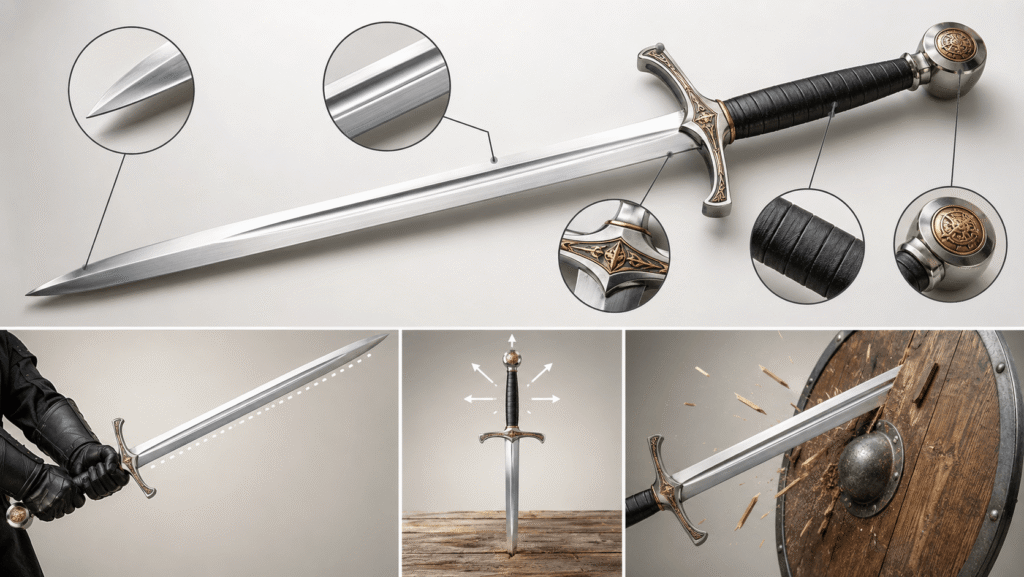
A sword isn’t simply a sharpened piece of steel with a handle attached. It’s a carefully balanced system where every component influences how the weapon performs. Even a small change to one part can affect the sword’s speed, balance, durability, and overall handling.
The blade provides the cutting and thrusting capability, but without a properly designed hilt, the sword would be difficult or even dangerous to use. Likewise, a strong tang is essential for holding the entire weapon together, while the pommel and guard help create the balance that makes the sword feel responsive in the hand.
Think of a sword as a team of interconnected parts rather than individual components. Each one has a specific purpose, and together they create a weapon that’s both effective and reliable.
Blade and Hilt: Two Parts Working as One
Although the blade attracts most of the attention, the hilt is just as important.
The blade generates cutting power and delivers thrusts, while the hilt allows the user to control that power. Without a secure grip, an effective guard, and a properly balanced pommel, even the finest blade becomes difficult to handle.
This relationship explains why experienced collectors rarely judge a sword by its blade alone. Instead, they evaluate the entire construction, paying close attention to how all the components work together.
Why Balance Matters
One of the biggest factors that separates a well-made sword from a poor one is balance.
Many people assume heavier swords are automatically more powerful. In reality, a properly balanced sword often feels surprisingly light because its weight is distributed efficiently.
The pommel acts as a counterweight to the blade, moving the center of balance closer to the user’s hand. This improves control, allows faster recovery after each strike, and reduces fatigue during extended use.
A sword that’s too blade-heavy may deliver powerful cuts, but it can feel sluggish and difficult to maneuver. On the other hand, a sword balanced too close to the hilt may move quickly but sacrifice cutting power.
Historical swordsmiths spent centuries refining this balance to match each sword’s intended purpose.
The Tang Holds Everything Together
While the tang is hidden from view, it’s arguably the most important structural component of the entire sword.
Every strike transfers force through the blade into the tang. That force then travels through the grip and into the user’s hand. If the tang is poorly made, even an expensive-looking sword can become unsafe during use.
This is one reason functional replica swords use a properly constructed full tang rather than the thin welded rods commonly found on decorative display pieces.
Simply put, the tang is the backbone of the sword’s construction.
Small Changes Can Transform a Sword
One fascinating aspect of sword design is that relatively small modifications can dramatically change how a weapon performs.
For example:
- A longer grip provides more leverage and better two-handed control.
- A heavier pommel shifts the balance closer to the hand, making the sword feel more agile.
- A longer blade increases reach but also adds weight.
- A deeper fuller reduces overall weight while preserving much of the blade’s strength.
- A larger guard offers greater hand protection but may slightly increase the sword’s overall weight.
Master swordsmiths carefully balanced these elements to create weapons suited for specific fighting styles, whether that meant delivering powerful cuts, precise thrusts, or versatile battlefield performance.
Common Myths About Sword Parts
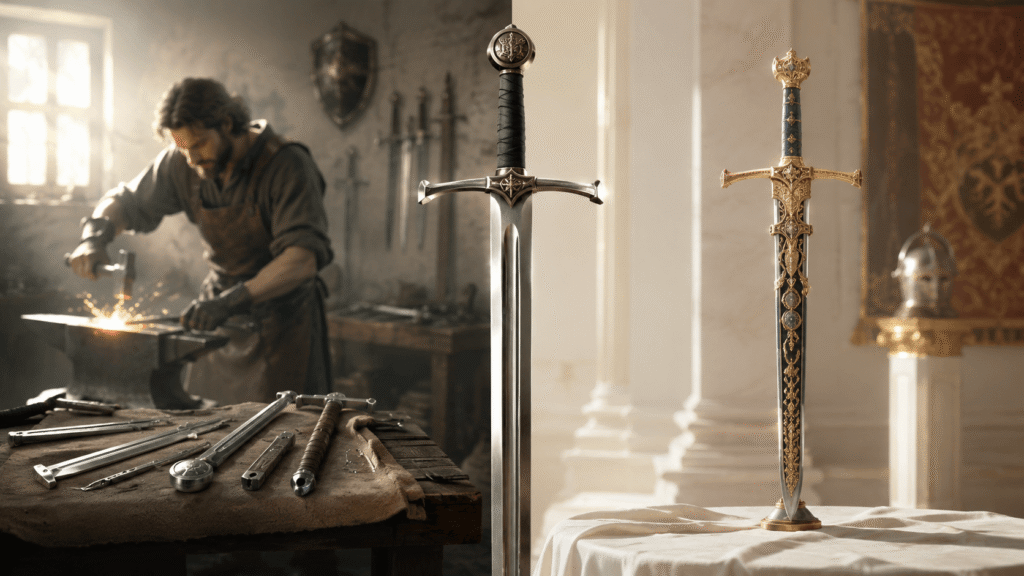
Despite centuries of research, myths about sword anatomy continue to circulate online, in movies, and even in some video games. Let’s separate fact from fiction.
Myth #1: The Fuller Is a Blood Groove
This is by far the most common misconception.
The fuller wasn’t designed to allow blood to flow or to make a sword easier to remove after a thrust. Its actual purpose is to reduce weight while maintaining structural strength, much like the I-beam used in modern construction.
Myth #2: Heavier Swords Are Always Better
Historical European swords were far lighter than many people imagine.
Most one-handed swords weighed between 2 and 3 pounds (0.9–1.4 kg), while many longswords weighed only 2.5 to 4 pounds (1.1–1.8 kg).
Rather than relying on sheer weight, swordsmiths focused on achieving the right balance between speed, control, and cutting power.
Myth #3: Every Sword Has Two Sharp Edges
Not all swords are double-edged.
Many famous weapons, including falchions, sabers, messers, and katanas, feature only a single cutting edge. Their designs were optimized for different styles of combat while still remaining highly effective.
Myth #4: The Bigger the Guard, the Better
A larger guard doesn’t automatically make a sword superior.
The ideal guard depends on the weapon’s intended purpose. Medieval arming swords often use simple crossguards, while rapiers feature elaborate hand protection because they were designed primarily for thrust-oriented fencing.
Each design reflects the type of combat for which the sword was created.
Myth #5: Decorative Swords and Functional Swords Are Built the Same Way
Although they may look similar, they’re often constructed very differently.
Functional swords are designed to withstand repeated stress and are typically built with high-carbon steel, proper heat treatment, and a strong full tang. Decorative swords, on the other hand, prioritize appearance over structural strength and generally aren’t intended for cutting practice or martial arts.
European vs Japanese Sword Anatomy
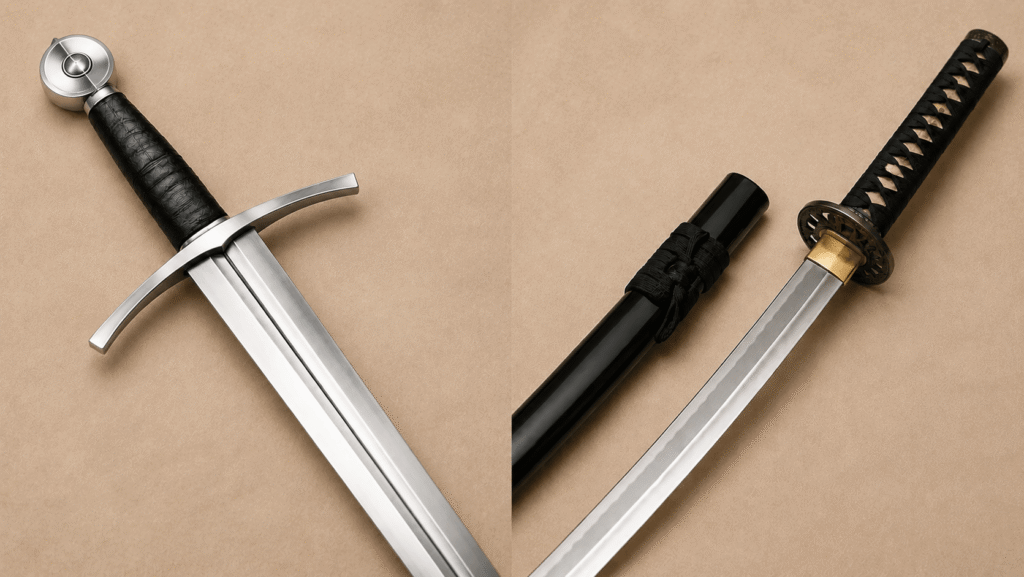
Although European swords and Japanese swords share the same basic principles, their construction and terminology differ considerably. Understanding these differences helps collectors recognize the unique design philosophies behind each weapon.
| European Sword | Japanese Sword (Katana) | Function |
|---|---|---|
| Blade | Blade | Primary cutting and thrusting surface |
| Guard | Tsuba | Protects the hand |
| Grip | Tsuka | Handle wrapped for secure grip |
| Tang | Nakago | Hidden extension of the blade inside the handle |
| Pommel | Kashira | End cap of the handle (not a counterweight like most European pommels) |
| Fuller | Bo-Hi | Reduces weight and improves handling |
One major difference is the pommel. On most European swords, the pommel serves as a counterweight that helps balance the blade. Traditional katanas, however, rely on different weight distribution and therefore don’t require a heavy pommel.
The tang also differs in construction. European swords are commonly peened at the pommel to lock the hilt together permanently, while Japanese swords are secured using one or more bamboo pegs called mekugi, allowing the sword to be disassembled for maintenance.
Despite these differences, both traditions pursued the same objective: creating a weapon that balances strength, control, and efficiency.
FAQ
What are the main parts of a sword?
The main parts of a sword are the point, edge, spine, fuller, ricasso, guard, grip, tang, and pommel. Together, these components determine the sword’s strength, balance, and handling characteristics.
What does a pommel do?
The pommel acts as a counterweight that improves balance and handling. It also helps secure the hilt assembly to the tang on many European swords.
What is a fuller?
A fuller is a groove forged into the blade to reduce weight while maintaining much of its structural strength. Contrary to popular belief, it is not a blood groove.
What is the difference between the guard and the hilt?
The guard is only one component of the hilt. The hilt refers to the entire handle assembly, including the guard, grip, and pommel.
Do all swords have a ricasso?
No. While many European swords include a ricasso, numerous historical swords transition directly from the blade to the guard without one.
What is the purpose of the spine?
The spine provides structural support and rigidity to the blade, helping it resist bending during heavy impacts while maintaining overall strength.
Why is sword balance so important?
A properly balanced sword feels lighter, moves faster, and is easier to control. Balance affects cutting power, recovery speed, maneuverability, and user fatigue.